It was around 2 a.m. and I was staring at a five minute gold chart, watching green candle after green candle march higher. I did not know it yet, but on the four hour chart price was pressing straight into the top of a range it had failed to break three times that month. I bought. I bought right where the bigger sellers had been waking up all week, and I had no idea, because I never zoomed out. That night was my first real lesson in gold market structure, in how BOS and CHoCH only tell the truth when you read them top down. It was 2017, the year I owed money to a man who counted interest by the day, and gold took what I had and then a little more that I had borrowed to win it back.
I survived that year, but not because I found a magic setup. I survived because I stopped guessing and started reading structure in a fixed order. This post is that order. By the end you will be able to open any XAU/USD chart, run one clean pass, and say out loud what state the market is in and where your read would be proven wrong. That last part matters as much as the first.
Before we go further, one plain warning. Gold is high risk. It is usually traded with leverage, and leverage magnifies losses as much as gains, so on a fast move your loss can be larger than the money you put in. This is education about a method of reading, not personal financial advice. Every number below is one way to picture the thinking, never a promise.
Structure is just higher highs and higher lows
Forget the fancy words for a minute. Price structure is only the trail of turning points that price leaves behind. A swing high is a peak with lower candles on both sides. A swing low is a valley with higher candles on both sides. That is the whole vocabulary.
When gold makes a higher high than the last peak, then a higher low than the last valley, that is an uptrend. Buyers are winning. When it makes a lower low, then a lower high, that is a downtrend. Sellers are winning. When peaks and valleys stop climbing or falling and just bounce inside a box, that is a range. Nobody is winning, and price is still deciding.
Think of a person walking up a staircase. Each step lands higher than the last. As long as the steps keep rising, they are going up, even if they pause on a landing. The trend breaks the moment they take a clear step down onto a lower stair. You do not need an indicator to see that. You need your eyes and a little patience.
Gold does this on every timeframe at once, and that is where people get lost. The five minute can be climbing stairs while the four hour is walking down them. Both are true. Neither is lying. They are just different sized maps of the same road. If you want the full picture of where this reading sits in the process, start with the pillar guide to reading gold and come back here for the structure step.
The top down pass, in order
This is the routine I run before I care about any entry. It takes a few minutes. Run it the same way every time until it feels dull, because dull is what keeps you safe.
Start on the daily chart. Ask one question and answer it in a full sentence: is gold making higher highs and higher lows, lower highs and lower lows, or is it stuck in a range? Do not guess the future here. Just describe the present. Mark the most recent major swing high and swing low with a line.
Drop to the four hour chart. Ask the same question. Now notice one more thing: does the four hour agree with the daily, or does it disagree? Maybe the daily is up but the four hour has just started stepping down. Write down which one it is.
Drop to the one hour chart. Same question again. This is usually where you start planning, but only inside the story the bigger charts already told you.
Look back at what we just did. We did not start by hunting a trade. We built a nest of context first. The daily sets the mood. The four hour sets the plan. The one hour sets the timing. When someone asks me why I took a gold trade, my answer always starts two timeframes above the one I entered on.
Gold market structure: BOS versus CHoCH
Continuation is not reversal. This is where most people flatten two very different events into one word and confuse themselves for years. “Break of structure” can mean the trend is carrying on, or it can mean the trend may be turning. Those are opposites. You have to keep them apart.
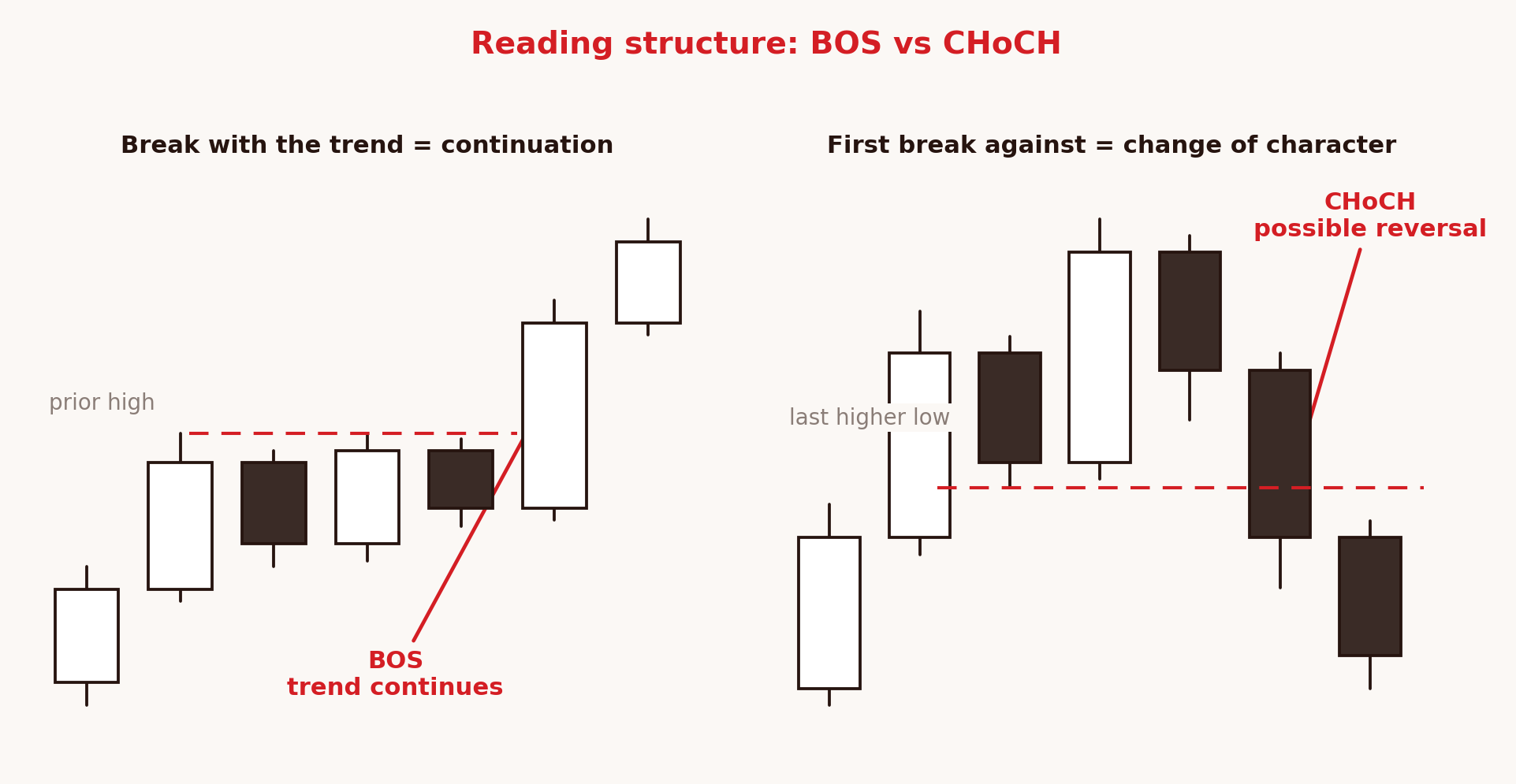
A break in the direction of the trend is continuation. Say gold is in a clean uptrend, stepping up, higher highs and higher lows. It pulls back, forms a higher low, then pushes up and closes above the previous swing high. That break above the old peak is a Break of Structure, or BOS, in the direction the market is already going. It is the staircase adding another step. It does not warn you of anything. It confirms buyers are still in control, and it hands you a place to work. On the next pullback you look for buys. You do not chase the candle that just broke.
A break against the trend is a Change of Character. Now say gold has been falling, lower highs and lower lows, sellers in charge. Then price pushes up and closes clearly above the last lower high, the first time in a while it has broken the wrong way for the trend. That first counter trend break has its own name, a Change of Character, often written CHoCH. It is the staircase taking its first clear step in the other direction. It does not mean the trend has reversed. It means the character of the move just shifted, and a reversal is now on the table where a moment ago it was not.
So keep the two straight. A BOS with the trend says the current direction is intact and gives you a spot to join it. A CHoCH is the market’s first honest hint that control may be passing to the other side. When I see a clean CHoCH on the four hour after a long downtrend, I do not run and buy. I note it. I say, sellers just lost this level, from here I lean toward buys rather than sells, and I wait for proof. Structure does not tell you to enter. It tells you which side of the boat to stand on.
A plain worked example
Let me walk one all the way through, so BOS and CHoCH stop being letters and start being a picture.
Say gold has spent two weeks climbing on the daily. Nice higher highs, nice higher lows. Round the levels for the story: it lifts from 2,300 to a swing high near 2,380, pulls back to a higher low around 2,340, then pushes up and closes at 2,395, clearly above that old 2,380 peak. That close above 2,380 is a Break of Structure with the trend. The staircase added a step. My read is simple: buyers still own this, so on the next pullback into the area they defended, I look for a buy, I name my risk below the last higher low, and I wait for a trigger before I do anything.
Notice what the structure did and did not do. It told me the direction and the side to favor. It did not tell me where to enter. That comes later, at a zone and with confluence, which is a different job for a different step.
Now watch the exact same read fail
Here is the part most guides skip. The same read, same chart, can hand you a loss, and you need to see how.
Rewind to that 2,380 peak. Everyone can see it. Everyone parks a stop just above it. Now one fast candle spikes through to 2,383, triggers all those stops, and closes back below 2,380 within minutes. If you called the break real on the wick, you bought the high of the day. That was not buyers taking control. That was the market feeding on the obvious level and moving on. People call it a false break, a stop hunt, or a liquidity grab. Gold loves this. It whips fast, and the cleaner and more obvious the level looks, the more orders are stacked there for it to eat.
So how do you protect yourself? Wait for the close, not the wick, before you call any break real. A five second spike that reverses is noise. A candle that closes past the level and then holds is worth respecting. On gold I would rather be one candle late and right than one wick early and wrong.
And here is the honest bottom line. You cannot tell a real break from a trap with total certainty in the moment. Nobody can. That is exactly why I put risk before method. You read structure to tilt the odds a little in your favor, then you define where you are wrong so a trap costs you a small, planned amount and nothing more. I said tilt, not guarantee. There is no sure setup in gold, only a plan and a place to be wrong cheaply.
When timeframes fight, you stand aside
Some days you run the top down pass and the charts simply disagree. The daily grinds up. The four hour just broke down. The one hour chops sideways in a tight box. There is no clean story.
New traders hate this and force a trade anyway. I used to. Sitting out felt lazy, like a real trader always has a position. That belief cost me more than any single bad entry ever did. When the timeframes contradict each other, the correct read is often no read. Standing aside is a decision, not a failure. A day with no clear structure is a day the market is telling you it has not decided. Let it decide without your money in the ring. Being able to say “I am flat because the daily and four hour disagree” is one of the clearest signs you have stopped guessing and started reading.
Want the one-page version to keep at your desk?
I made a free download called The Gold Read Card. It is a one page pre-trade checklist in HARCOS red and white: context, structure, zone, session, confluence, risk, trigger, in the order I actually run them. No cost, no pressure. If it helps you slow down for one honest pass before you click, it did its job. Grab it and pin it next to your screen.
Where structure fits, and where it stops
Structure tells you which way the road runs and which side to favor. It does not tell you where gold will actually react, and it does not tell you when to pull the trigger. Those are the next steps.
Gold reacts at specific places where buyers and sellers have shown up before. Those are your supply and demand zones on XAU/USD, and structure is how you decide which zones matter. Direction and a zone still leave the question of when, and gold behaves very differently across the Asian, London, and New York hours, which is why trading gold by session belongs in the plan before you time anything. Then, once you have a direction, a zone, and the right hour, you still do not enter on hope. You wait for reasons to line up, which is confluence and the trigger. Read in that order, every time, and the fog you came in with starts to lift.
This same order, big picture down to a defined risk entry, is the spine of my book, Reading Gold: A Repeatable Method for XAU/USD. If a post like this makes the reading click, the book walks the full path one careful step at a time.
FAQ
What is the difference between BOS and CHoCH on gold?
A Break of Structure (BOS) is a break in the direction the trend is already going, so it confirms the trend and continuation. A Change of Character (CHoCH) is the first break against the trend, so it hints that control may be passing to the other side. One says keep going, the other says maybe not yet.
How do I avoid getting trapped by a fake break on XAU/USD?
Wait for a candle to close past the level and hold, rather than reacting to a wick that pokes through and snaps back. Gold often spikes past an obvious high or low to grab stops before reversing. Being one candle late and right beats being one wick early and wrong. Even then, no break is certain, so define your risk first.
Which timeframe should I read gold structure on?
Read top down. The daily sets the mood, the four hour sets the plan, the one hour sets the timing. Plan on the lower timeframe only inside the story the higher ones already told. If they disagree, standing aside is a valid read.
Does a CHoCH mean the trend has reversed?
No. A CHoCH means the character of the move just shifted and a reversal is now possible where it was not before. It is a hint to watch, not a signal to flip your whole bias. Wait for proof and name where you are wrong.
About the author
My name is Marcus, founder of HARCOS INVEST FX. I did not come from money or a trading desk. I came from a bad year and a loan I could not pay, and I learned the hard way that being clever about gold means nothing if you cannot control what you lose. HARCOS is an open door community of gold traders who care more about surviving and improving than looking like geniuses online. We show our work, including the losing and cancelled trades. There is no rush and no secret setup behind a paywall. You trade with us, at your own pace and your own risk, and the door stays open whenever you are ready.
Risk note: Trading gold (XAU/USD) is high risk and leverage can cause losses greater than your deposit. This article is education, not personal financial advice. Only risk money you can afford to lose.