One morning years ago I sat waiting to buy gold. I had a clean demand zone drawn on the four hour chart, the kind you feel good about. Price drifted down and tapped it exactly where I had drawn the line. I clicked buy. Then I watched price slide straight through the zone like it was not even there, while most of the market was still asleep. The zone was fine. My reasons were fine. Trading gold by session was the piece I had ignored. I had asked a quiet, half awake market to do something only a loud, awake market tends to do.
The chart was right. The clock was wrong.
That trade taught me a lesson I keep relearning. Gold does not trade the same all day. The same line on the same chart can be a brick wall at one hour and a wet paper bag at another. If you have read where I teach reading market structure and drawing supply and demand zones, this is the step that puts a clock next to your map. A level with no sense of timing is only half a read.
Gold keeps office hours
Think of gold like a street market. Early in the morning a few stalls open and a few people wander in. It is slow. You can walk down the middle of the road. Then the trucks arrive, the crowd pours in, and suddenly you cannot move without bumping shoulders. Later the crowd thins, the stalls pack up, and by night it is quiet again.
Price behaves the same way. When more traders and more money are active, moves get bigger and follow through more often. When few people are active, price drifts, chops, and pokes at levels with no commitment. Your zones do not change. The energy hitting them does.
For gold, two windows carry most of that energy. London, when Europe comes online, and New York, when the United States joins in. There is also an Asian window earlier in the day, usually the quiet one. I am not going to hand you exact clock times, and I will explain why later. Your screen already shows them, and time zones and daylight savings shift things around. What matters is the shape, not the minute.
If you want the full walk from big picture down to a defined entry, that lives in my pillar guide on reading gold. This post zooms in on one link in that chain, the one most new traders skip.
Trading gold by session: the three windows
Here is the shape I watch for. Not a rule. A tendency.
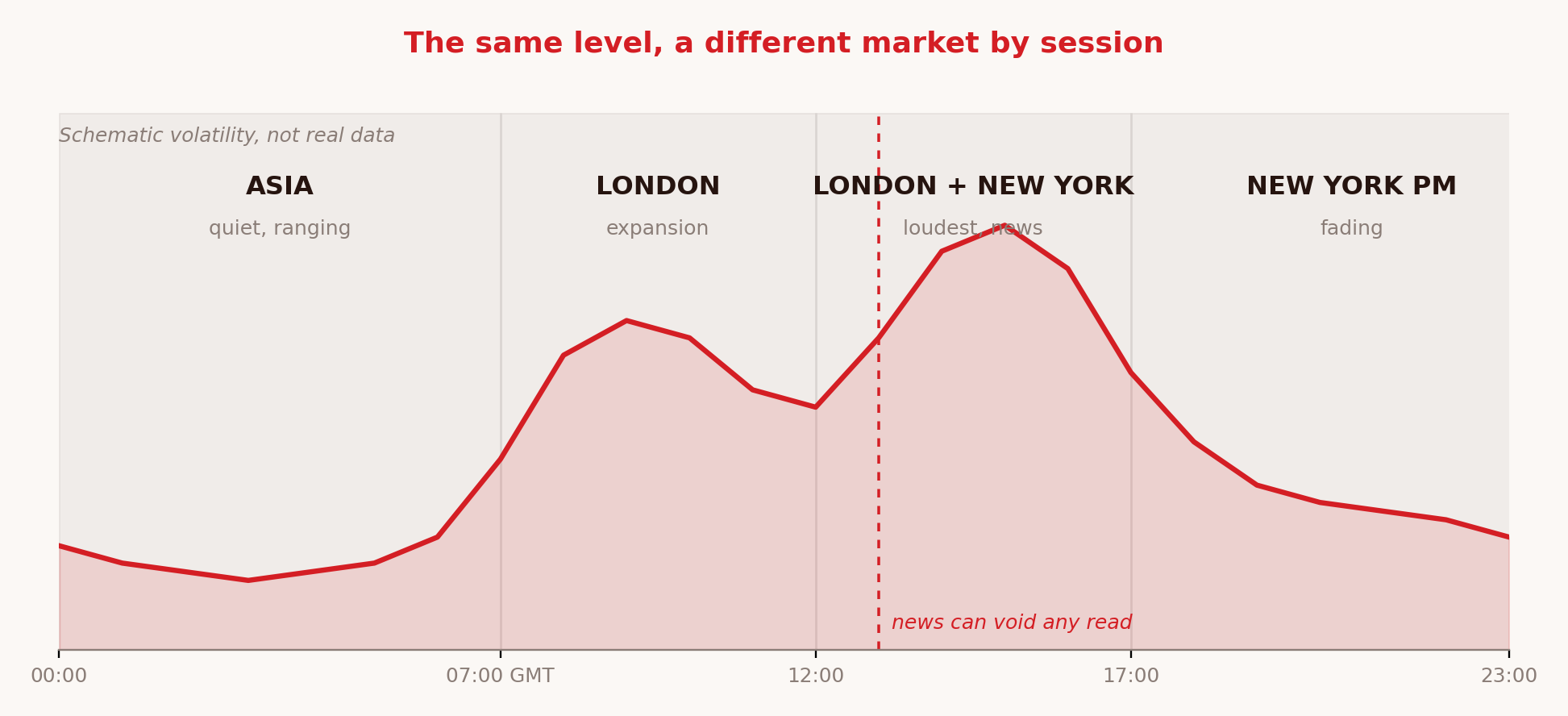
The Asian window is often the calm before the noise. Price tends to build a tight range, a small box. Not always, but often. I treat that box as information, not as a trade. The high and the low of that quiet range become lines I care about later in the day.
London is usually the first real push. Volume steps up. Price often reaches for one side of the Asian box, sometimes breaking it clean, sometimes faking a break and turning back. This is where a real trend for the day can begin.
New York brings the second wave, and the biggest one when United States news lands. London and New York overlap for a stretch, and that overlap is often the loudest, fastest part of the day. It can extend a London move, or it can rip it apart and reverse it.
So the same demand zone tells three different stories. Tapped in the Asian quiet, it may just get leaned on with no follow through. Tapped as London opens, it may launch. Tapped during a New York news spike, it may get blown through before you blink, then reclaimed a minute later. Same zone. Different clock. Different behavior.
This is why I say timing is context, not a signal. The session never tells you to buy or sell. It tells you how much to trust the move you are already seeing, and how much room price is likely to travel. That is a filter, not a trigger.
Reading your idea into a window
When I build a trade idea now, I do not only ask where. I ask where, and in which session does this make sense.
Say my top down read is bullish, and I have a clean demand zone sitting below current price. That is my where. Now I add the when.
If price is drifting down into that zone during the Asian quiet, I usually just watch. There is not enough energy behind the move to trust either the tap or the bounce. I would rather let London decide. Standing there with my finger off the button is not me being slow. It is me refusing to pay for a move the market is not ready to make.
If price reaches my zone as London wakes up, now the context fits. There is fuel in the market to turn a level into a move. I pay full attention. I still need a trigger and a named risk before I act, but at least the session is on my side.
If price is already running in my direction and New York opens with a data release, I know the next few minutes can be violent in both directions. Often the smarter move is not to chase the spike but to wait for it to settle and show its hand.
The point is simple. The session sets my expectation for how much price should move, and how much I should trust the move. A ten dollar swing means one thing in the quiet and something else when the whole market is awake. Ten dollars is only an example here to show the thinking, not a promise about any day.
The trap hiding in high liquidity
Here is the part most people get backwards. New traders assume the busy hours are the safe hours, because that is when the real moves happen. But the high liquidity windows are also where false signals cluster the thickest.
Picture a public swimming pool. Early morning, almost empty, the water flat like glass. You toss in a pebble and the ripple travels clean across the surface. That is the Asian session. Small cause, clean effect, but not much happening.
Now it is noon on a hot day. The pool is packed, kids jumping, everyone splashing. Toss in the same pebble and you will never even see the ripple. The water is chaos. That is a New York news window. Huge energy, but hard to read one clean signal inside all the noise.
Neither pool is better. You just fish differently in each. In the calm pool you read small ripples. In the crowded pool you wait for the big waves and refuse to confuse a random splash for a real one. Most account damage I have seen, and I have done my share, comes from treating a crowded pool like a calm one, reacting to every splash as if it meant something.
A breakout that would be meaningful at a quiet hour can be pure noise during the overlap, a stop run dressed up as a signal. More activity does not mean more clarity. It often means more traps. Remember too that gold usually trades on leverage, which magnifies both sides, so a noisy window can take more than you planned to risk. The session context is what tells you which pool you are standing in.
A free tool for this exact moment. I put the whole pre-trade read on one page called The Gold Read Card. Context, structure, zone, session, confluence, risk, trigger, in the order I actually check them. It is a free download, no pressure, and it lives in red and white so it is easy to glance at before you click. If a printed checklist would slow your hand down at the right moment, grab it.
A short session checklist
Before you take any gold idea, run these five questions. It costs about fifteen seconds, and it has kept me out of more bad trades than any indicator ever did.
- What session is it right now on my chart? Asian quiet, London open, New York, or the London and New York overlap.
- What did the Asian range look like today? Note its high and its low. Are we above it, below it, or still inside it.
- Does the energy of this session match the move I want to trade? A big continuation idea in a dead session is a mismatch.
- Is major news due in this window? If yes, expect fast, two sided moves and wider swings. Plan for noise, not calm.
- If the session is unclear, or I am between windows, am I allowed to stand aside? Yes. Waiting is a position.
Write your answers in one line before you act. If three of the five point to low energy or unclear conditions, that is usually a stand aside, not a trade.
When the market ignores the clock
Sessions are a tendency, not a timetable. Do not turn this into a superstition. Every technique in reading gold can fail, and this one fails in three ways I want you to see coming.
First, gold does not read the clock. Some of the cleanest trends I have watched started in the quiet Asian window and never looked back. Some London opens did nothing at all and chopped sideways all day. If you assume London always trends, or Asia is always flat, the market will happily take money from that assumption. The session tells you what is likely, not what is owed to you.
Second, and this is the big one, news is the biggest trap. A release does not politely move price one direction. It often spikes up, spikes down, wipes both sides of the stops, then picks a way. If you enter right into that moment because New York looks strong, strength can mean strongly against you first. The stop you thought was safe can get clipped in the noise before your idea plays out. News can void any read you have. When high impact data is due, the honest move is often no trade at all. That is not the method failing. That is you standing in the crowded pool and blaming the water.
Third, there is the timezone trap, which is why I never hand out fixed hours. Daylight savings shifts, your broker’s server time, and your own local clock can all disagree. If you memorize a number instead of watching real activity, you will show up to the party an hour early or an hour late. Read the actual pickup in movement on your chart, not a time you wrote down last spring.
And the overlap can betray you. The London and New York window is often where a clean morning move suddenly reverses hard, because United States traders disagree with Europe. A trade that looked settled all morning can flip. Respect it. Do not marry the morning’s direction.
So use the session as a filter that raises or lowers your confidence, never as a stand in for a real trigger and a real risk plan. The clock narrows your choices. It does not make the choice for you.
Do this now
Open your gold chart and mark today’s Asian range with two horizontal lines, its high and its low. Then mark, roughly, where London woke up and where New York joined, using the visible jump in movement, not a fixed hour. Do this for the next five trading days without taking a single trade from it. Just watch how price treats those lines in each window. You are training your eye to feel the difference between the calm pool and the crowded one.
Once you can name the session and the energy behind a move, you are ready for the next question. When several reasons to take a trade line up at the same spot, the top down bias, the zone, and the session, that is confluence, and it feels powerful. In my post on gold confluence and the trigger I show you how to use that carefully, and how to catch the moment it stops being real evidence and quietly turns into you talking yourself into a trade you already wanted.
If you want to see this done in the open, HARCOS INVEST FX is a community of gold traders who show their work, the losing and cancelled trades included. The door is open whenever you want to walk through it. No rush, no last chance, no secret setup behind a paywall. And the full method, from big picture to journal, is laid out in order in my book Reading Gold: A Repeatable Method for XAU/USD, if you would rather read it quietly on your own. That is a good path too.
Trade the process, not the guess.
FAQ
What are the main gold trading sessions?
The three windows most gold traders watch are the Asian session, usually the quiet one where a tight range forms, the London session, which often brings the first real push, and the New York session, which brings the second wave and the biggest moves when United States news lands. I avoid quoting fixed hours because daylight savings and your broker’s server time shift them. Watch the actual pickup in movement on your own chart instead.
Which session is best for trading gold?
There is no single best session, and anyone who promises you one is selling something. London and the London to New York overlap carry the most energy, but energy cuts both ways. More activity means bigger moves and more false signals. The right session is the one whose energy matches the trade idea you already have, not a magic hour that wins for you.
Should I trade gold during news releases?
Be very careful. A release can spike both directions and clip your stop before your idea plays out. News can void any technical read you have. Many days the honest choice around high impact data is no trade at all, or waiting for the move to settle and show its hand before you act.
Does trading gold by session guarantee better results?
No. Nothing here guarantees anything. Session timing is context that raises or lowers your confidence in a move. It is not a signal on its own, and it never replaces a real trigger and a defined risk plan. Gold is high risk, it is usually leveraged, and no read is ever safe.
About the author
My name is Marcus, and I am the founder of HARCOS INVEST FX. I did not come from money or a trading desk. In 2017 I blew up a trading account while I was already in debt to a man who counted interest by the day, and I learned the hard way that being clever about gold means nothing if you cannot control what you lose. What saved me was boring. I put risk first and built a process I could repeat when I was calm and, more importantly, when I was not. HARCOS grew out of that, a community of gold traders who care more about surviving and improving than looking like geniuses online. I am not a guru, and I will never tell you I found a way to get rich fast. I would rather trade a plan with you than sell you a promise.
Risk note: Trading gold (XAU/USD) is high risk and usually leveraged, which can lose more than you deposit, so treat this as education, not personal financial advice, and risk only money you can afford to lose.