The worst click of my life took half a second. It was 2017. I owed money to a man who counted interest by the day, and gold had walked down to a level I circled the night before. My hand was on the mouse. Everything I had read said this was the spot, so I bought. The next candle sliced through the level and kept falling. Account red, I sat there and asked the only honest question left. Why right then, at that exact second, and not one candle later?
I had no answer. And with no answer, I had no business clicking anything. What I was missing had a name. Gold trade confluence and entry trigger, the read that decides whether a level is worth acting on, and exactly when.
This is the read I run now, in a fixed order, before I ever touch buy on gold. Confluence, then named risk, then trigger, then entry, then management, then the journal that closes the loop. If you want the whole method from the top, start with the pillar guide to reading gold. Here I want to zoom in on the part where most accounts quietly die, the space between “this looks good” and the click.
Confluence is a filter, not a magnet
Picture leaving the house, wondering if it will rain. The sky is low and grey. The radar on your phone is a wall of green. The air has that damp, metal smell it gets before a storm. Three signs, from three different places, all saying the same thing. You grab the umbrella.
That is confluence. Several independent reasons pointing the same way. In trading, the reasons come from the lenses you already know. Context, what actually moves gold. Structure, read from the top down. Zones, where price has clearly reacted before. Session, whether London or New York tends to respect this kind of move or fade it. Lay those four on top of each other like sheets of tracing paper and look through the whole stack at once.
Here is the part most traders get backwards. Confluence is not there to make you feel sure. It is there to help you say no. It is a way to throw trades away, not a way to bless the ones you keep.
I learned this trading my way out of a hole, when I could not afford to be casually wrong. I could only take the setups that survived deletion. So I built my checklist to say no by default, and let a trade through only when it earned the yes. You start every situation assuming you will not trade. The market has to talk you into it, layer by layer. If the layers cannot do that, the silence is your answer, and standing aside is a complete, finished, professional decision.
Count rooms, not reasons
A trader I work with, Samir, once brought me a chart he was completely sure about. “Five reasons, Marcus. I checked everything.” He was already in, three times his usual size, because five reasons felt like five times the certainty.
I asked him to list them. Trend up. Price at a demand zone. London open. A bullish candle. RSI oversold. Then I asked one question. Are any of those the same reason wearing different clothes? He went quiet, because they were. RSI oversold and price at demand describe the same event. A bullish candle at the London open is one fact with a timestamp, not two facts. What looked like five witnesses was really two, both staring at the same corner of the room.
So do not ask how many reasons you have. Ask how many different rooms they come from. Three reasons from three rooms beat six reasons from one room, every time.
When the reasons all agree and all lie
Now the part the umbrella already taught you. Even with all three signs lined up, you did not bet your whole day on staying dry. You took the umbrella anyway. Because three signs make rain likely, not certain. A front can slide past and drop nothing, and then the sky, the radar, and the wind were all wrong together, in perfect agreement.
Confluence lies most convincingly right when it feels strongest. A single piece of news, a large order you cannot see, a shift in the dollar, and your four neat agreements become four wrong opinions holding hands. And there is a quieter failure. The more reasons you stack, the more your size tends to creep up, exactly like Samir tripling his. Confidence and position size are supposed to be separate decisions. Confluence loves to marry them, and that is how a good read turns into an oversized loss.
So treat a full checklist as permission to consider a trade with defined risk, never as a reason to press harder. The layers lining up tells you the setup is worth your attention. It never tells you the trade will work. No setup is safe. Hold both of those thoughts at once and you will survive the days your best looking read is simply wrong.
Name the loss first, before you think about entry
Here is where I break from how most people trade. Before I draw a single arrow toward a target, before I think about getting in, I name the loss. Out loud. In writing. This is the habit that kept me in the business long enough to have anything worth teaching.
Invalidation is a heavy word for a plain question. Where would price go that proves my reason is no longer true? If you believe buyers defend a demand zone, a clean close below that zone means the buyers never showed. The story is dead. That closing level is your invalidation. It is a line you can point to, not “I will get out when it feels wrong.” Feelings drift. A feeling at two in the afternoon is a different animal from a feeling at two in the morning when you owe someone money. The line does not drift, which is why you write it while you are calm.
The stop goes just beyond the invalidation. Not glued to the exact line. Gold wicks. Price pokes a level, grabs a few orders, then snaps back, especially around news. Sit your stop right on the edge and every normal wobble clips you. Push it a little past, enough to survive an ordinary wick and not a dollar more. Too close and noise sweeps you out. Too far and each loss costs more than it should.
Size comes from the loss, not from the dream. Almost nobody does this in the right order at the start. They pick a size because they want to make a certain amount, then drop the stop wherever there is room left. That exact order buried me in 2017. Flip it. Decide once the fixed slice of your account you will risk on any single trade. Many careful traders I respect keep it small, around one percent, some less. Call that amount 1R, one unit of risk. On a 10,000 dollar account, one percent is 100 dollars, so 1R is 100 dollars. That figure is only a way to picture the math, not a target or a promise. Measure the distance from your planned entry to your stop, work out what that costs per lot, and divide your 1R by it. The size decides itself. A wider stop means a smaller size. The account stays protected, because the R stays fixed.
If you cannot name the invalidation, you do not have a trade. You have a hope. And it is far cheaper to learn that on paper than with money on the line.
Want the read on one page? I made a free one-page checklist called The Gold Read Card. Context, structure, zone, session, confluence, risk, trigger, in the order I actually run them before a trade. Red and white, print it, tape it above your screen. Grab it free from HARCOS, no strings, and stop trying to hold the whole sequence in your head at the moment your palms are sweating.
Wait for the trigger. A zone is an invitation, not a promise
Now you have reasons that agree and a loss that is named. That is still not a reason to click.
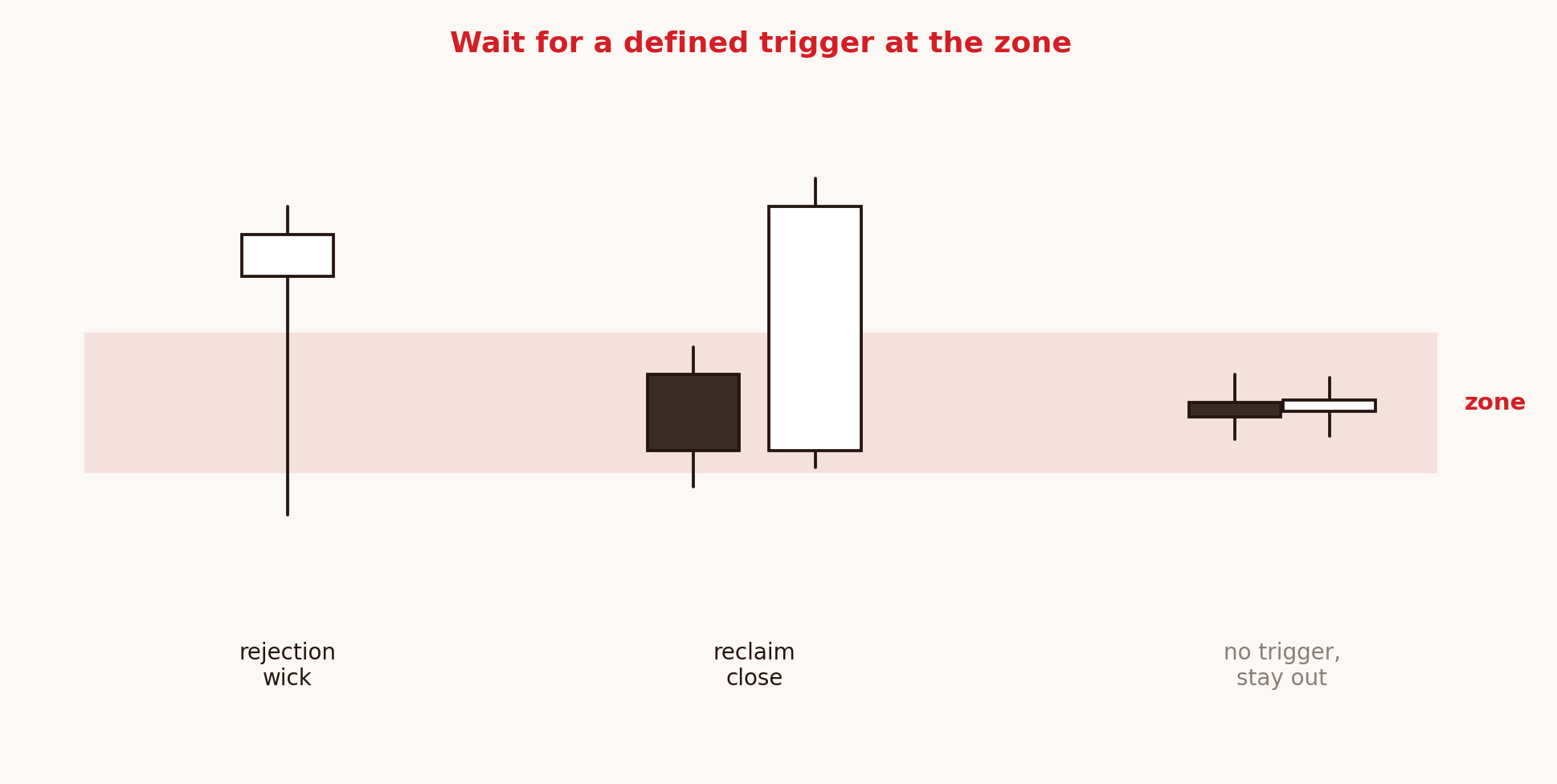
A zone is a place. Risk is a plan. Neither one is a signal. Price can walk into your zone and do nothing. It can touch the level and keep sliding. Standing at your zone with your finger ready is like standing at a crosswalk. You know this is where you cross. That does not mean you step into the road. You wait for the light. The trigger is your light.
A trigger is a specific event you write down before it happens. Not a feeling, not “it looks strong.” A sentence you could hand to a stranger, and they would know exactly what to wait for. A rejection candle that closes with a long tail poking into the zone and its body back out. A shift in momentum, where the fast red candles slow, turn heavy, then one closes back above a small level the sellers had been holding. A break above a small ceiling inside the reaction that then does not fall back through. They share one trait. Each either happens or it does not. There is no “kind of.” You want triggers you can score with a plain yes or no, because a yes or a no is something you can wait for without arguing with yourself at midnight.
And a trigger can be bait. Price prints a beautiful rejection candle, you enter, and the very next candle reverses and stops you out. This is real, and it has taken money from me more than once, usually around news when big orders move fast. So a trigger is never enough on its own. It needs a partner, a cancel condition, the thing that tells you the trigger failed. If your rejection candle prints and then price closes right back inside the zone and keeps going against you, that is your cancel. A good trigger with no cancel condition is just a nicer way to guess.
Enter as executing a plan, not making a decision
By the time price reaches your zone, the thinking should already be done. If you are still asking “should I take this,” you did your work too late.
I write an order ticket, seven boxes, in this order on purpose, risk first. Invalidation. Stop. Entry, the exact trigger condition. Target, or targets. The reward-to-risk gate, where I check the realistic target sits at least about one and a half to two times my risk away, or I fold the ticket. Size, worked out from the stop distance, arithmetic and not a feeling. And a one line reason I can say in a single breath. If any box is empty, I do not enter. Not “enter smaller.” Not “enter and figure it out.” I do not enter.
The click is not the decision. The click is carrying out a plan I already wrote. The order ticket is a recipe card taped above the station, so that when adrenaline floods in, and it will, I am reading instead of inventing.
Even a perfectly filled ticket is only a guess with structure around it. Every box can be right and gold can still run to your stop. That is not the method failing. It is the nature of a guess. The stop is you agreeing, in advance, that the answer might be no. And because the size box was arithmetic, that no costs you a planned 1R, not your account.
Manage by rules, and close the loop with a journal
Entering is the easy half. Manage the open trade by rules you set before the click, not by hope. When price reaches plus 1R, I move my stop to break even, so the trade can no longer hurt me. When it reaches the target I wrote down, I take the exit I planned instead of inventing a new, better dream. Same setup, different weather. On another day the same trade stops at break even for zero, or hits the stop for minus 1R. The process does not change.
Then the last skill, the one that holds all the others together. A trade is not finished when the position closes. It is finished when it is written down and reviewed. I keep it to ten lines I can fill in ninety seconds. Session, direction, context reason, zone, trigger, invalidation, risk in R, result in R, “did I follow my plan, yes or no,” and one honest note.
The most important line is “did I follow my plan,” because it is the only line I can choose to repeat. Gold does not owe you a clean lesson. You can do everything right and lose. You can do everything wrong and win. So grade the decision, not the result. Once a week I look at my clean trades that lost and my sloppy trades that won. The winning sloppy trades are the dangerous ones, because the account went up while the habit went bad. Outcome sorting would tell me to repeat them. The scorecard tells me the opposite, and the scorecard is right.
Gold trade confluence and entry trigger, the loop in one breath
Confluence to reject, not to fall in love. Name the loss first, set the stop, size by R. Wait for a written trigger with a cancel condition. Enter by executing the ticket. Manage and exit by rules set in advance. Journal within two minutes, grading the plan over the profit. That is the whole read, top to bottom.
If you want it laid out step by step with examples, the full method walkthrough opens the door. I also wrote a book on it, “Reading Gold: A Repeatable Method for XAU/USD,” which teaches this exact order, one careful chapter at a time. And HARCOS is where I trade beside other people who show their work, including their losing and cancelled trades. The door is open if you ever want to walk through it. No rush, no last chance, no secret setup behind a paywall. If you would rather take these pages and practice quietly on your own, that is a good path too, maybe the better one for you. I mean that.
Trade the process, not the guess.
FAQ
What does confluence mean in gold trading?
Confluence is several independent reasons pointing the same direction. Context, structure, zone, and session agreeing about gold. The key word is independent. Five reasons that are secretly the same reason are one reason in a costume, not five.
Should I enter as soon as price reaches my zone?
No. A zone earns your attention, not your money. Price can touch a level and keep sliding right through it. Wait for a defined trigger, a specific event you wrote down in advance, and pair it with a cancel condition that tells you the trigger failed.
Why name the loss before thinking about the entry?
Because the entry feels like winning and the loss feels like admitting you might be wrong, so most people skip the hard part. Naming your invalidation, placing your stop, and sizing by a fixed percentage first is what makes any single wrong trade survivable.
Does this process guarantee winning trades?
No, and anyone who promises that is not being honest with you. No setup is safe. A perfect read can still lose. The process cannot make you right. It can only keep being wrong small and survivable, and give you a record you can actually learn from.
About the author
My name is Marcus, founder of HARCOS INVEST FX. I did not come from money or a trading desk. In 2017 I blew up an account while I was already in debt, and I learned the hard way that being clever about gold means nothing if you cannot control what you lose. The thing that saved me was boring. I put risk first and built a process I could repeat when I was calm and, more importantly, when I was not. I am a trader who kept records and kept going. I am not a guru, and I will never tell you I found a way to get rich fast, because I did not.
Trading gold (XAU/USD) is high risk, is usually traded with leverage so losses can exceed the amount you deposit, and this article is education about a method, not personal financial advice; risk only money you can afford to lose.