For about two years I traded gold with the sound off. I could draw a level, I could name a candle, and I still got run over on mornings when the market seemed to decide something before I woke up. What I was missing was not a better indicator. It was an answer to a plain question. What moves the price of gold, and is any of it happening today?
I want to be careful with the word “moves” here. Nobody can tell you where gold is going. Not me, not a bank, not a man with a countdown timer on a sales page. But the market does have weather, and weather has causes. Learning those causes will not make you right. It will stop you from being confused, and confusion is what makes people click at the worst possible moment.
So this is the honest version. Five forces, what each one actually does, where the real numbers live, and how I use all of it in about ten minutes a week. If you want the full order of operations from mood to management, the pillar guide to reading gold lays out all eight steps. This article is step one, done properly.
Gold has no earnings, so it is priced by what it costs to hold
Start with the strangest thing about this market. A company can report profits. A bond pays a coupon. Gold does nothing. It sits in a vault, it pays you no interest, and it charges you storage.
That single fact explains more price behaviour than any pattern I know. If money in a savings account or a government bond is paying you well after inflation, holding a metal that pays nothing is expensive. If that same safe return collapses, the cost of holding gold falls with it, and gold becomes easier for large investors to justify.
This is why gold traders end up watching central banks even when they never wanted to. Not because rates are exciting, but because rates set the rent on owning gold.
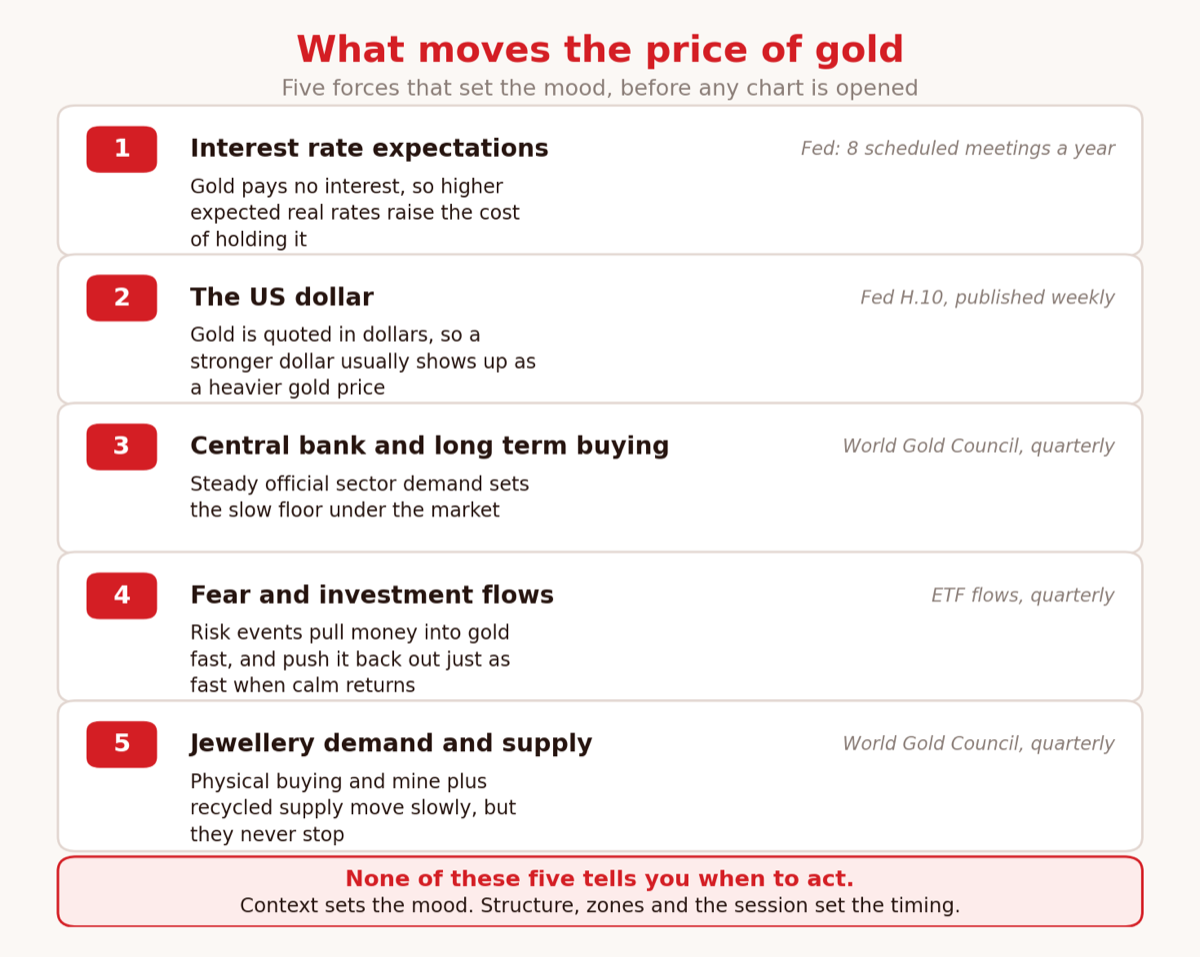
What moves the price of gold: the five forces I check
1. Interest rate expectations
The important word is expectations. Markets do not wait for a decision to be announced before they price it. By the time a rate decision hits the wire, a large part of the expected outcome is already in the price, which is why gold can jump on a decision that matched what everyone predicted. It was not the number. It was the wording, or the press conference, or one sentence about what comes next.
The US Federal Reserve publishes its schedule openly, and it is worth knowing the shape of it. The Fed holds eight regularly scheduled meetings a year, and the minutes of those meetings are released three weeks after the decision.
Do the arithmetic and you get something useful. Eight decisions plus eight sets of minutes is sixteen dated events a year, which averages out to roughly one scheduled Fed moment every twenty three days. On the 2026 calendar the decisions sit six to seven weeks apart. That is the assumption baked into the number, that we only count the regular schedule and ignore speeches and unscheduled meetings.
Sixteen days out of about two hundred and fifty trading days is not many. It also means the excuse “the news is why I lost” only covers a small share of the year. Most of the time gold moves for no headline reason at all, which is the part beginners find hardest to accept.
2. The US dollar
Gold is quoted in dollars. That is a plumbing detail with real consequences. When the dollar strengthens broadly against other currencies, the same ounce of gold buys more dollars than before, so the quoted price tends to feel heavy even when nothing about gold itself changed. When the dollar weakens, the reverse pressure shows up.
The relationship is loose, not mechanical. There are stretches where gold and the dollar rise together, usually when both are being bought for the same nervous reason. Anyone who tells you the correlation is a rule has not watched enough of them break.
If you want the underlying data rather than someone’s chart of it, the Federal Reserve publishes foreign exchange rates in the weekly H.10 release. I do not trade off it. I use it the way you glance at a barometer, to know which way the pressure is leaning.
3. Central banks and long term buyers
Underneath the daily noise there is a slower current: institutions that buy gold in size and are not trying to scalp it. Central banks diversifying reserves, funds holding a strategic allocation, families in gold buying cultures who buy on birth, marriage and festival regardless of the chart.
The scale is easy to underestimate. According to the World Gold Council, total gold demand including over the counter trading topped 5,000 tonnes in 2025, in a year that saw 53 all time highs in the gold price. In the first quarter of 2026 demand came in at 1,231 tonnes, with the value of that demand at a record 193 billion dollars.
Notice what those numbers do and do not tell you. They do not tell you what next Tuesday looks like. They tell you that the buyer on the other side of your trade is often not a trader at all, and that person has no stop loss and no intention of leaving.
4. Fear, and the money that moves with it
This is the force everyone knows about and almost everyone uses badly. When something frightening happens in the world, money moves toward assets that have survived previous frightening things, and gold is on that short list.
The trap is the timing. Fear flows are fast in both directions. Money arrives in a rush and it can leave just as quickly when the story loses its edge. The same World Gold Council reporting showed exchange traded fund flows in the United States reversing sharply within a single quarter in early 2026, wiping out inflows that had built up over previous weeks.
So the lesson I take from fear is not “buy gold when there is bad news.” It is “expect wider ranges and thinner liquidity when the world is nervous, and size accordingly.” Fear is a volatility forecast, not a direction forecast.
5. Jewellery, mine supply and recycling
The slowest force, and the one that never appears in a trading chatroom. Jewellery demand rises and falls with affordability. Mine supply changes over years, not weeks. Recycling picks up when prices are high and people sell old chains at the counter.
None of it will help you with an intraday decision. It matters because it is the floor under the whole structure. When the World Gold Council reports jewellery volumes falling while spending on jewellery still hits records, that tells you something honest about a market where price is high enough to change behaviour without killing demand.
The calendar is the part most people skip
Here is the practical use of everything above, and it costs you five minutes.
Before the week starts, I look at what is scheduled. Is there a rate decision this week? Are minutes due? Is there a major inflation or jobs release? I am not predicting the outcome. I am deciding, in advance and while calm, how I want to behave around it.
My own rule is simple and boring. In the hours around a scheduled high impact release I either stand aside, or I am already in a position with a stop I accepted before the news existed. What I do not do is enter fresh in the minute before a release, because in that minute the spread widens, the fill is unpredictable, and the honest description of what I am doing is gambling with extra steps.
As I write this in early August 2026, the most recent Fed decision landed at the end of July, its minutes are due three weeks after that decision, and the next scheduled decision is in mid September. That is a stretch of weeks with no scheduled rate event in it. Knowing that changes how I read a quiet Tuesday. It is not the calm before something. There is nothing on the calendar. The calm is the whole story.
Why none of this tells you when to click
I need to be blunt, because this is where macro reading turns into lost money.
Knowing what moves the price of gold tells you about the mood. It does not tell you where to enter, where you are wrong, or how much to risk. I have watched people build an excellent macro argument and then lose the account anyway, because a correct opinion executed with no plan is just an expensive way to be right.
The order that works for me runs downhill from slow to fast. Context sets the mood. Structure tells me which way the market has actually been resolving. Zones tell me where a decision is likely to be made. The session tells me whether this hour is the kind that respects the level or runs through it. Only then, at the very end, does confluence and a written trigger decide whether I do anything at all.
Macro is the first filter, not the last word. If I skip it, I trade blind into a scheduled event. If I stop there, I have an opinion and nothing else.
My ten minute routine
Sunday evening or Monday morning, I answer four questions in a notebook. They take longer to explain than to do.
First, what is scheduled this week, and on which days am I standing aside. Second, which way has the dollar been leaning over the last few weeks, in one word: firmer, softer, or unclear. Third, what is the market’s current story about rates, and, more importantly, has that story changed since last week. Fourth, and this is the one that saves money, what would have to happen for my read to be wrong.
That fourth question is the whole discipline in miniature. If I cannot say what would prove me wrong, I do not have a view. I have a hope.
I write the answers in four short lines. Not a report. Nobody reads it but me. What it buys me is that when gold moves hard on Wednesday, I am not meeting the situation for the first time with money on the line.
The two years I got this backwards
I want to tell you how I learned this, because I did not learn it from a book.
Back when I was trading my way out of debt, I treated news as a source of entries. A headline would land, I would decide what it meant, and I would click, usually late, usually large, because the move was already running and I was scared of missing it. My reasoning felt sophisticated. My results were the results of a man chasing a bus.
The change was small and unglamorous. I stopped asking “what does this news mean for gold” and started asking “what does this news mean for how I should behave today.” Same information, completely different question. One invites a prediction. The other produces a decision I can actually control, such as trading smaller, waiting for a level, or doing nothing.
Doing nothing is a position. It took me an embarrassingly long time to accept that.
What moves the price of gold, in one breath
Real interest rate expectations set the cost of holding an asset that pays nothing. The dollar sets the unit the price is quoted in. Central banks and long term buyers set the slow floor. Fear sets the speed and the size of the swings. Jewellery and supply set the background. The calendar tells you which days deserve extra caution, and none of these five tells you when to click.
If you take one habit from this article, take the calendar check. It is free, it takes five minutes a week, and it removes a whole category of avoidable loss: the loss you take on a day you should not have been trading in the first place.
Where to go next
If you are new here, start here is the short introduction to who I am and how this site is organised. If this way of thinking makes sense to you, the full method walks through all eight steps in order, from reading the mood to journalling the trade. There is also a free one page summary I put together, The Gold Read Card, which is the checklist I actually run before I risk anything. It costs nothing and there is no form to fill in.
If you want the long version, I wrote a book about it called Reading Gold: A Repeatable Method for XAU/USD. And HARCOS is where I trade alongside other people who show their work, including the trades that lose and the ones we cancel before entry. Following along is free. The book is optional. If you would rather take these pages and practise quietly on your own, that is a perfectly good path, and for some people it is the better one. I mean that.
Trade the process, not the guess.
FAQ
What moves the price of gold the most?
Over months and years, expectations about real interest rates tend to be the heaviest single force, because gold pays no income and rates set the cost of holding it. On any single day, though, investment flows and positioning can dominate completely, which is why a good macro view can still be badly wrong about tomorrow.
Does gold always rise when there is bad news?
No. Gold often attracts money during frightening events, but flows reverse quickly and sometimes gold falls in a crisis because investors are selling whatever they can to raise cash. Treat fear as a forecast of bigger swings, not a forecast of direction.
Why does gold fall when the US dollar rises?
Gold is priced in dollars, so a broadly stronger dollar usually shows up as a heavier gold price for the same underlying value. The relationship is a tendency, not a law, and it breaks regularly, so it should never be used on its own as a reason to trade.
Do I need to follow economic news to trade gold?
You do not need to forecast it, and I would gently suggest you should not try. What helps is knowing what is scheduled, so you can decide in advance whether to stand aside, and so a violent move never arrives as a total surprise while you are holding a position.
How often does the Federal Reserve meet?
The Federal Open Market Committee holds eight regularly scheduled meetings each year, and it publishes the minutes of those meetings three weeks after each decision. The schedule is published in advance on the Federal Reserve’s own website, so there is no need to rely on second hand summaries.
About the author
I am Marcus, founder of HARCOS INVEST FX. I am an entrepreneur and a working trader sharing how I think, not a teacher and not a guru. I came into this market in debt and with more confidence than skill, and gold charged me tuition for it in 2017. What eventually kept me here was not a clever read on the economy. It was putting risk first, writing things down, and building a process I could repeat on the days I felt calm and, more importantly, on the days I did not. Everything here is my personal perspective, and no entry, stop or target discussed should be treated as a signal.
Trading gold (XAU/USD) is high risk, is usually traded with leverage so losses can exceed the amount you deposit, and this article is education about how one trader reads the market, not personal financial advice. Figures quoted are from the sources linked and were correct at the time of writing. Risk only money you can afford to lose.