The message arrives in some form almost every week. Usually it is polite, sometimes it is embarrassed, and it is always the same question. How much money do you need to start trading gold? People expect me to name a figure. They want to hear five hundred, or two thousand, or ten thousand, and then go away and either feel qualified or feel excluded.
I am not going to name a figure, and I want to explain why that is the useful answer rather than a dodge. The size of your account is not the thing that decides whether you survive. What decides it is the relationship between three numbers you control: the smallest position your broker will let you open, the distance to the point where you admit you were wrong, and the share of your money you are willing to lose finding out.
Get those three right and a small account behaves sensibly. Get them wrong and a large account dies slower, but it still dies. I know because I did the second one first.
The question that actually decides it
In 2017 I opened an account with money I could not afford to lose, while I already owed money to somebody counting interest by the day. I was not asking how much I needed to start. I was asking how fast I could make it grow, which is a completely different question wearing the same clothes.
The better question, the one I ask now, is this. What is the most I can lose on a single wrong idea and still be calm enough to take the next setup properly? That number is personal, it is small, and once you know it, the account size follows from arithmetic rather than ambition.
Why gold makes this question harder than it looks
Gold is an expensive thing measured in ordinary units. The market’s own unit of trading is large, and the retail contract most people meet, one standard lot of XAU/USD, represents one hundred ounces. A one dollar move in the price of an ounce is therefore a one hundred dollar move on a full lot. That is the whole reason leverage exists in this corner of the market, and it is also the reason accounts vanish so quickly here.
Regulators have looked hard at this. In the European Union, ESMA capped retail leverage on gold at 20:1 and published the reason: national regulators found that 74 to 89 percent of retail accounts typically lose money, with average losses per client ranging from 1,600 to 29,000 euros. Australia’s regulator reached the same cap. From March 2021, ASIC restricted gold contracts for difference to 20:1 for retail clients, after finding that during one volatile five week period in March and April 2020, the retail clients of a sample of thirteen providers made a net loss of more than 774 million dollars. In that same five weeks, more than 1.1 million positions were closed out automatically on margin, and over 15,000 accounts fell into negative balance owing a total of 10.9 million dollars.
Read that last part twice. Those are not people who lost their deposit. Those are people who ended up owing money after the deposit was gone. Rules in several countries now stop that from happening, but the underlying lesson stands. Leverage is not a feature that helps small accounts compete. It is the mechanism by which small accounts disappear.
So the practical way to think about capital in gold is upside down from how it is usually sold. You are not asking how much you need to control a big position. You are asking how little you can risk while still being allowed to place a trade at all.
How much money do you need to start trading gold: the arithmetic
Three steps. You can do this on the back of an envelope, and I would rather you did it that way than took my word for it.
Step 1: the smallest position your broker allows
Most retail brokers let you trade a hundredth of a standard lot. Since a standard lot is one hundred ounces, a hundredth of one is a single ounce, which means a one dollar move in the gold price is a one dollar move in your account. Check this yourself with your own provider, because the minimum size and the contract definition do vary, and this single number sets the floor under everything else.
Step 2: the distance to being wrong
Your stop is not a preference, it is a location. It sits where your reason for the trade stops being true, which is why structure and zones come before any talk of money. On gold that distance is commonly somewhere between a few dollars and a few tens of dollars per ounce, depending on the timeframe you work on and how volatile the week is.
Step 3: the percentage you accept losing
Now multiply. If your smallest position is one ounce and your stop sits ten dollars per ounce away, then one trade puts ten dollars at risk. For those ten dollars to be one percent of your account, the account has to hold a thousand dollars. At two percent, five hundred. If your method needs a twenty dollar stop, those same percentages point at two thousand and one thousand.
That is the entire answer, and notice what it is not. It is not a recommendation to deposit any of those amounts. It is a floor produced by your own inputs. Change the stop or change the percentage and the floor moves. What you cannot do is deposit two hundred dollars, use a twenty dollar stop, and pretend you are risking one percent, because the smallest trade available to you is already five percent of that account. The arithmetic has already made the decision, and it is not a decision you would have made on purpose.
The number nobody quotes you: how long a bad run lasts
Here is where most beginners get ambushed, and it is not by the market. It is by ordinary probability.
Suppose a method wins forty five percent of the time, which is a perfectly workable rate when the winners are bigger than the losers. I ran the numbers on a hundred trades. The chance of hitting at least one run of five consecutive losses is 92 percent. At least one run of six is 72.9 percent. At least one run of eight is 30.7 percent. Over two hundred trades, a run of six becomes 93 percent likely. I calculated these with a simple dynamic programming routine and then checked them again with a four hundred thousand run simulation, which produced the same figures. The assumption is deliberately simple, that every trade is independent and the win rate is constant.
Sit with that for a second. A run of six losses is not evidence that your method broke. At that win rate, over a hundred trades, it is the normal course of events, more likely to happen than not.
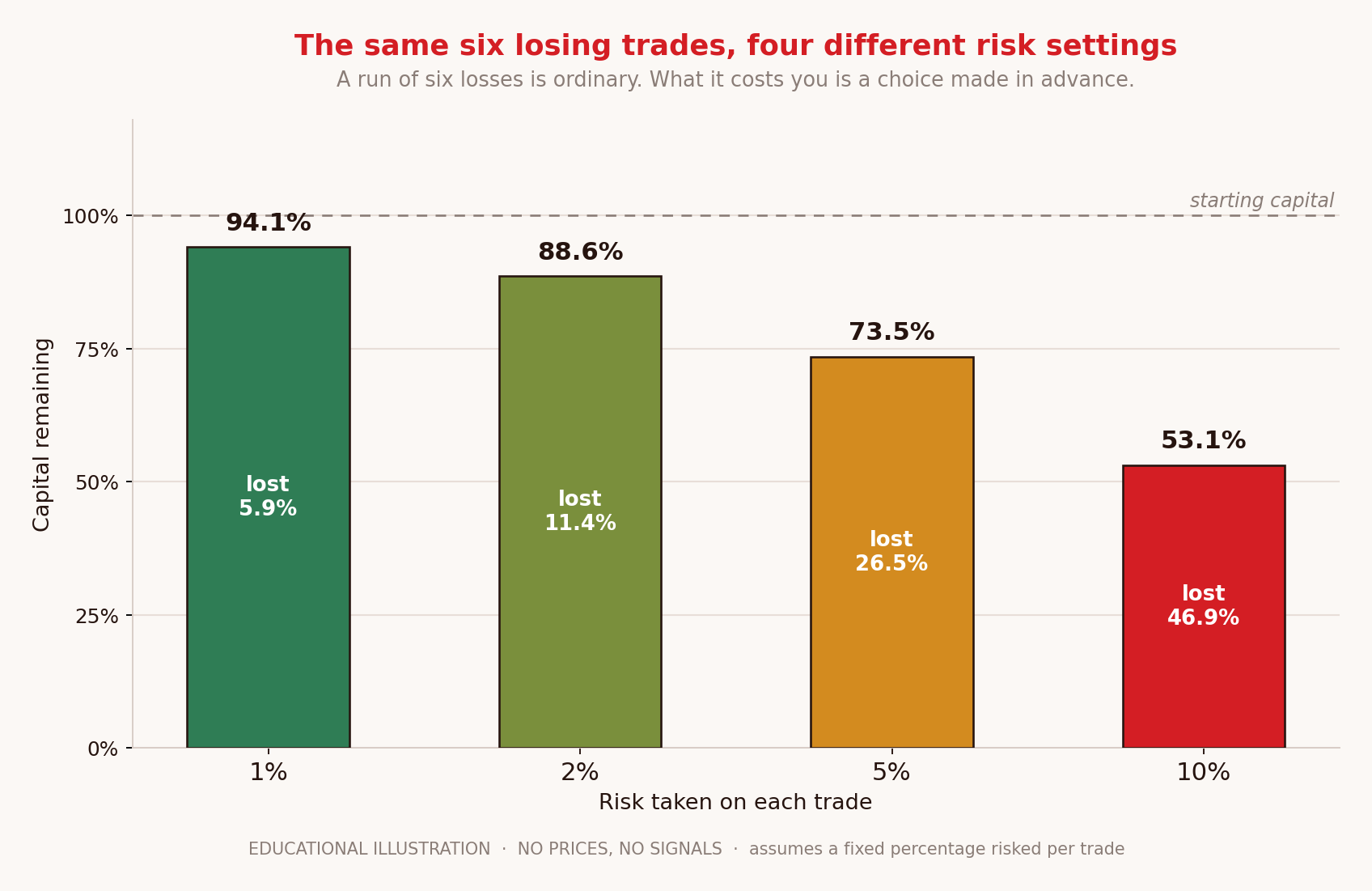
So the only real question is what a normal bad run costs you. Six losses in a row leaves you with 94.1 percent of your money if you risked one percent each time. It leaves 88.6 percent at two percent, 73.5 percent at five percent, and 53.1 percent at ten percent. And there is a cruel asymmetry hiding in those last two. Losing half your account does not mean you need fifty percent to get back. It means you need one hundred percent on what remains, which is why the traders who risk big rarely come back from the hole they dug in a single week.
This is what I mean when I say the deposit is the wrong thing to obsess over. Two people can start with exactly the same money and meet exactly the same six losses, and one of them still has a working account while the other is emotionally and financially finished.
What the regulators saw, and what it should tell you
I do not quote the ESMA and ASIC findings to frighten anybody away. I quote them because they are the only large scale, independently gathered numbers we have about how this actually goes for ordinary people, and they say the same thing from two different continents. Most retail accounts lose. Losses cluster in volatile periods. Leverage speeds it up.
Notice what those figures do not say. They do not say the market is rigged, and they do not say nobody survives. They say that the average outcome is negative, which means the interesting question is what the survivors do differently. In my experience it comes down to boring things. Small risk per trade. A stop placed before the entry. A written record. Time.
None of those cost money. All of them cost patience, which is the currency most beginners are short of, not capital.
The way I would actually think about the money
If it were me starting again, I would think about it in two buckets rather than one number.
The first bucket is tuition. This is money set aside to be spent learning, in the same way you would pay for any other training, and you should expect it to shrink. If losing it would change how you eat, sleep or treat the people you live with, it is not tuition. It is your life, and it does not belong in a leveraged market.
The second bucket is the working account, and it only gets funded after the first bucket has taught you something you can point to. Not a profit. A record. A few months of trades where you can show that you followed your own rules whether the trade won or lost. That is a far better qualification for adding money than any account balance.
I funded these in the wrong order. I put in money I needed, called it a working account, and had to learn the lessons anyway, only with fear sitting on my chest the whole time. Fear makes every part of this harder. It makes you take profits too early, hold losers too long, and skip the setups that would have worked. If you can avoid that by starting smaller than your ego would like, you have bought yourself something more valuable than leverage.
What money cannot buy you
A bigger deposit does not buy patience, and it does not buy a read. It just gives your existing habits more room to express themselves. If the habit is good, it compounds slowly. If the habit is chasing, it compounds a hole.
The things that actually decide the outcome are free to acquire and slow to build. Knowing what moves the price of gold before you look at a chart. Reading structure from the top down. Waiting for a trigger you wrote down in advance instead of entering because the level looked pretty. Deciding whether this hour of the session respects levels or runs through them. Writing the trade down afterwards and grading the decision rather than the result.
That is the whole job, and none of it appears on a deposit slip.
How much money do you need to start trading gold, in one breath
Enough that the smallest trade your broker allows is a small percentage of your account, not a large one. Work it out from your own stop distance and your own risk percentage, not from a number somebody quoted you. Then make sure it is money whose disappearance would not change your life, because a run of six losses is normal and you should meet it with arithmetic rather than panic.
If a figure did have to exist, it would be this. The right amount is the one that lets you make a hundred small, boring, well documented mistakes without needing the account to rescue you.
Where to go next
If you are new here, start here explains who I am and how these pages fit together. The full method walks through the eight steps in order, and step six is exactly the part this article turns into arithmetic, naming the loss before anything else. I also keep a free one page checklist, The Gold Read Card, which is what I run before I risk anything. No form, no email required.
The longer version lives in my book, Reading Gold: A Repeatable Method for XAU/USD. And HARCOS is where I trade beside people who show their working, including the losing trades and the ones we cancel before entry. Following is free, the book is optional, and if you would rather take this arithmetic and practise quietly on your own for six months, that is a genuinely good plan. Possibly a better one.
Trade the process, not the guess.
FAQ
How much money do you need to start trading gold?
There is no universal figure. Work it backwards: take the smallest position your broker allows, multiply by your usual stop distance to get the money at risk in one trade, then divide by the percentage you are willing to risk. That gives the smallest account that lets you trade your method honestly. It should also be money you could lose entirely without it changing your life.
Can I start trading gold with a hundred dollars?
You can open an account, but the arithmetic usually breaks. If the smallest trade you can place risks ten dollars, that is already ten percent of a hundred dollar account, and six ordinary losses in a row would take roughly half of it. A demo account or a much smaller stop distance is a more honest way to spend that first hundred dollars.
Is more leverage useful for a small account?
Leverage does not add money, it only enlarges the position you can open with the money you have, which enlarges the loss just as fast as the gain. Regulators in the EU and Australia capped retail gold leverage at 20:1 precisely because larger multiples were producing severe losses for ordinary clients.
How many losses in a row should I expect?
More than feels fair. On a method winning forty five percent of the time, a run of six consecutive losses is more likely than not within a hundred trades, and a run of five is close to certain. Plan the size of your risk around that being ordinary rather than exceptional.
Should I add money after a losing month?
Adding money does not fix a process problem, it funds it. The question I ask myself is whether my written records show I followed my own rules. If they do, the drawdown is weather. If they do not, more capital just buys more of the same behaviour.
About the author
I am Marcus, founder of HARCOS INVEST FX. I am an entrepreneur and a working trader sharing how I think about this market, not a teacher and not a guru. I started with borrowed confidence and money I needed, blew up an account in 2017 while I was already in debt, and the thing that eventually turned it around was not a better read on gold. It was accepting how little I was allowed to lose on any single idea, and building a process I could repeat when I was calm and when I was not. This is a personal perspective rather than a course, and no entry, stop or target discussed should be treated as a signal.
Trading gold (XAU/USD) is high risk, is usually traded with leverage so losses can exceed the amount you deposit, and this article is education about risk arithmetic, not personal financial advice or a recommendation to deposit any amount. Figures quoted come from the sources linked and were correct at the time of writing; calculations are my own and state their assumptions. Risk only money you can afford to lose.